← Jason's Brain

Jason Yim

Email: jason [at] yim.dev
Google Scholar· GitHub· X· LinkedIn

Website format inspired by the spartan, unadorned HTML websites of my researcher role models. My work spans machine learning theory, methods, and applications (primarily in protein design). The latest work can be found on Google Scholar or X.

My research interests center on generative models and their use in scientific discovery:

Updated on .

Selected papers

* denotes equal contribution.

Machine learning · Science

Machine learning

Discrete Flow Maps

Peter Potaptchik, Jason Yim, Adhi Saravanan, Peter Holderrieth, Eric Vanden-Eijnden, Michael S. Albergo
arXiv preprint 2026

The sequential nature of autoregressive next-token prediction imposes a fundamental speed limit on large language models. While continuous flow models offer a path to parallel generation, they traditionally demand expensive iterative integration. Flow Maps bypass this bottleneck by compressing generative trajectories into single-step mappings, theoretically enabling the generation of full text sequences from noise in a single forward pass. However, standard formulations rely on Euclidean regression losses that are geometrically ill-suited for discrete data. In this work, we resolve this conflict with Discrete Flow Maps, a framework that reconciles trajectory compression with the geometry of the probability simplex. We recast standard flow map training for the discrete domain, aligning the training dynamics with the discrete nature of language. Empirically, this strict geometric alignment allows our method to surpass previous state-of-the-art results in discrete flow modeling.
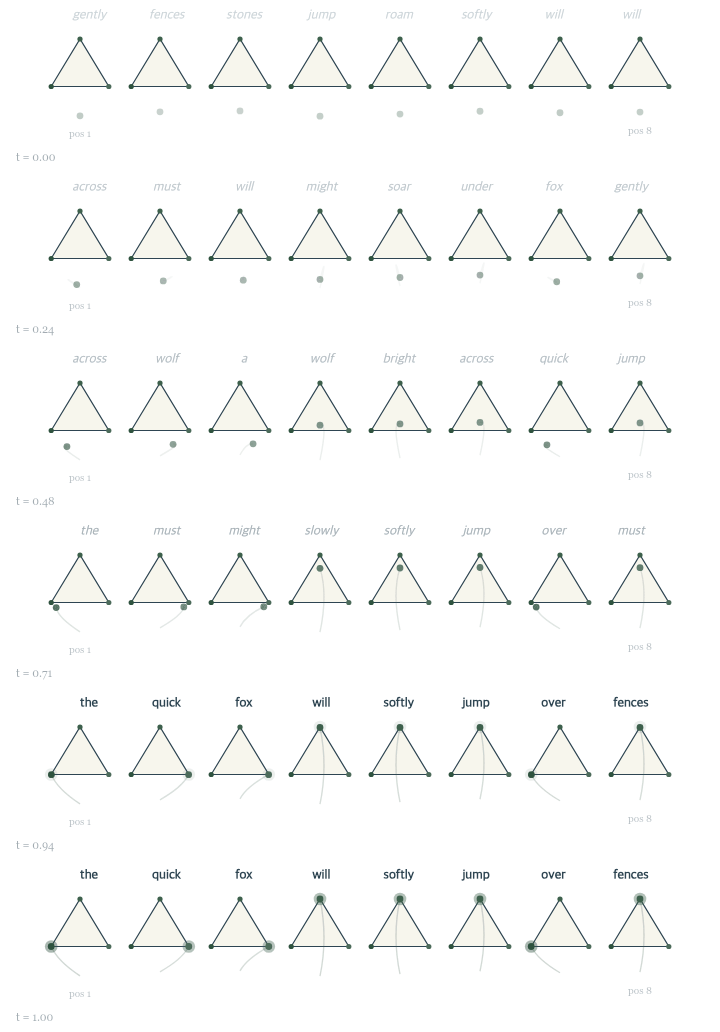
Discrete Flow Maps animation: tokens move from noise to simplex vertices as a sentence forms

Generative Flows on Discrete State-Spaces: Enabling Multimodal Flows with Applications to Protein Co-Design

Andrew Campbell*, Jason Yim*, Regina Barzilay, Tom Rainforth, Tommi Jaakkola
International Conference of Machine Learning 2024

Combining discrete and continuous data is an important capability for generative models. We present Discrete Flow Models (DFMs), a new flow-based model of discrete data that provides the missing link in enabling flow-based generative models to be applied to multimodal continuous and discrete data problems. Our key insight is that the discrete equivalent of continuous space flow matching can be realized using Continuous Time Markov Chains. DFMs benefit from a simple derivation that includes discrete diffusion models as a specific instance while allowing improved performance over existing diffusion-based approaches. We utilize our DFMs method to build a multimodal flow-based modeling framework. We apply this capability to the task of protein co-design, wherein we learn a model for jointly generating protein structure and sequence. Our approach achieves state-of-the-art co-design performance while allowing the same multimodal model to be used for flexible generation of the sequence or structure.

SE (3) diffusion model with application to protein backbone generation

Jason Yim*, Brian L Trippe*, Valentin De Bortoli*, Emile Mathieu*, Arnaud Doucet, Regina Barzilay, and Tommi Jaakkola
International Conference of Machine Learning 2023

The design of novel protein structures remains a challenge in protein engineering for applications across biomedicine and chemistry. In this line of work, a diffusion model over rigid bodies in 3D (referred to as frames) has shown success in generating novel, functional protein backbones that have not been observed in nature. However, there exists no principled methodological framework for diffusion on SE(3), the space of orientation preserving rigid motions in R3, that operates on frames and confers the group invariance. We address these shortcomings by developing theoretical foundations of SE(3) invariant diffusion models on multiple frames followed by a novel framework, FrameDiff, for learning the SE(3) equivariant score over multiple frames. We apply FrameDiff on monomer backbone generation and find it can generate designable monomers up to 500 amino acids without relying on a pretrained protein structure prediction network that has been integral to previous methods. We find our samples are capable of generalizing beyond any known protein structure.

Generator Matching: Generative modeling with arbitrary Markov processes

Peter Holderrieth, Marton Havasi, Jason Yim, Neta Shaul, Itai Gat, Tommi Jaakkola, Brian Karrer, Ricky T. Q. Chen, Yaron Lipman
International Conference on Learning Representations 2025 (Oral)

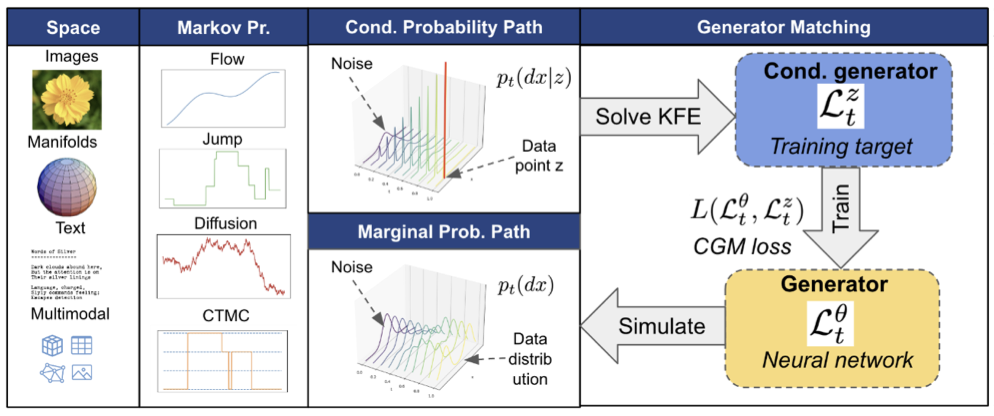
We introduce Generator Matching, a modality-agnostic framework for generative modeling using arbitrary Markov processes. Generators characterize the infinitesimal evolution of a Markov process, which we leverage for generative modeling in a similar vein to flow matching: we construct conditional generators which generate single data points, then learn to approximate the marginal generator which generates the full data distribution. We show that Generator Matching unifies various generative modeling methods, including diffusion models, flow matching and discrete diffusion models. Furthermore, it expands the design space to new and unexplored Markov processes such as jump processes. Finally, Generator Matching enables the construction of superpositions of Markov generative models and enables the construction of multimodal models in a rigorous manner. We empirically validate our method on image and multimodal generation, e.g. showing that superposition with a jump process improves performance.

Generator visualization

Improved motif-scaffolding with SE (3) flow matching

Jason Yim, Andrew Campbell, Emile Mathieu, Andrew YK Foong, Michael Gastegger, José Jiménez-Luna, Sarah Lewis, Victor Garcia Satorras, Bastiaan S Veeling, Frank Noé, and others
Transactions on Machine Learning Research 2024

We present FrameFlow, a method for fast protein backbone generation using SE(3) flow matching. Specifically, we adapt FrameDiff, a state-of-the-art diffusion model, to the flow-matching generative modeling paradigm. We show how flow matching can be applied on SE(3) and propose modifications during training to effectively learn the vector field. Compared to FrameDiff, FrameFlow requires five times fewer sampling timesteps while achieving two fold better designability. The ability to generate high quality protein samples at a fraction of the cost of previous methods paves the way towards more efficient generative models in de novo protein design.

Hierarchical protein backbone generation with latent and structure diffusion

Jason Yim, Marouane Jaakik, Ge Liu, Jacob Gershon, Karsten Kreis, David Baker, Regina Barzilay, Tommi Jaakkola
ICLR 2025 Workshop on Generative and Experimental Perspectives for Biomolecular Design

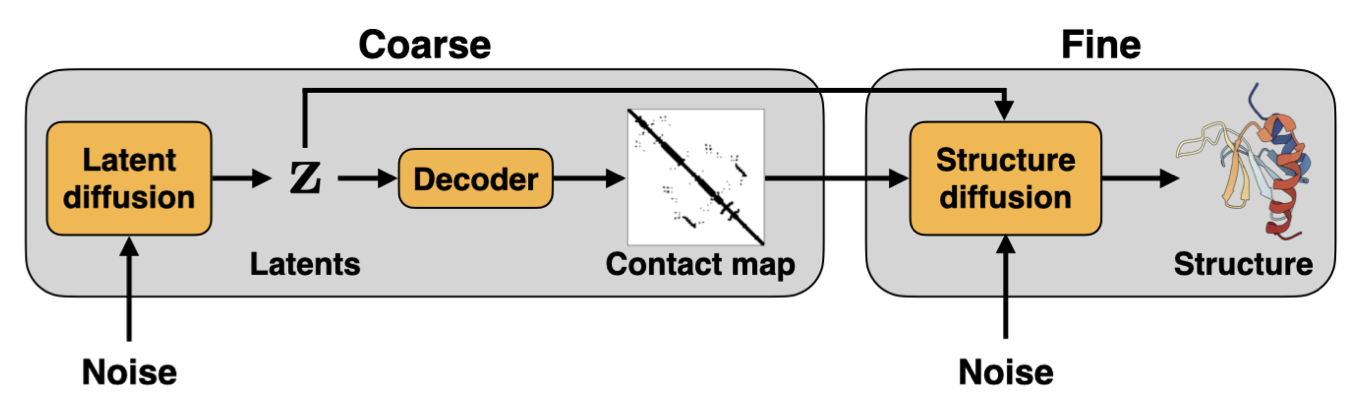
We propose a hierarchical protein backbone generative model that separates coarse and fine-grained details. Our approach called LSD consists of two stages: sampling latents which are decoded into a contact map then sampling atomic coordinates conditioned on the contact map. LSD allows new ways to control protein generation towards desirable properties while scaling to large datasets. In particular, the AlphaFold DataBase (AFDB) is appealing due as its diverse structure topologies but suffers from poor designability. We train LSD on AFDB and show latent diffusion guidance towards AlphaFold2 Predicted Alignment Error and long range contacts can explicitly balance designability, diversity, and noveltys in the generated samples. Our results are competitive with structure diffusion models and outperforms prior latent diffusion models.

LSD visualization

Proteína: Scaling Flow-based Protein Structure Generative Models

Tomas Geffner*, Kieran Didi*, Zuobai Zhang*, Danny Reidenbach, Zhonglin Cao, Jason Yim, Mario Geiger, Christian Dallago, Emine Kucukbenli, Arash Vahdat, Karsten Kreis
International Conference on Learning Representations 2025 (Oral)

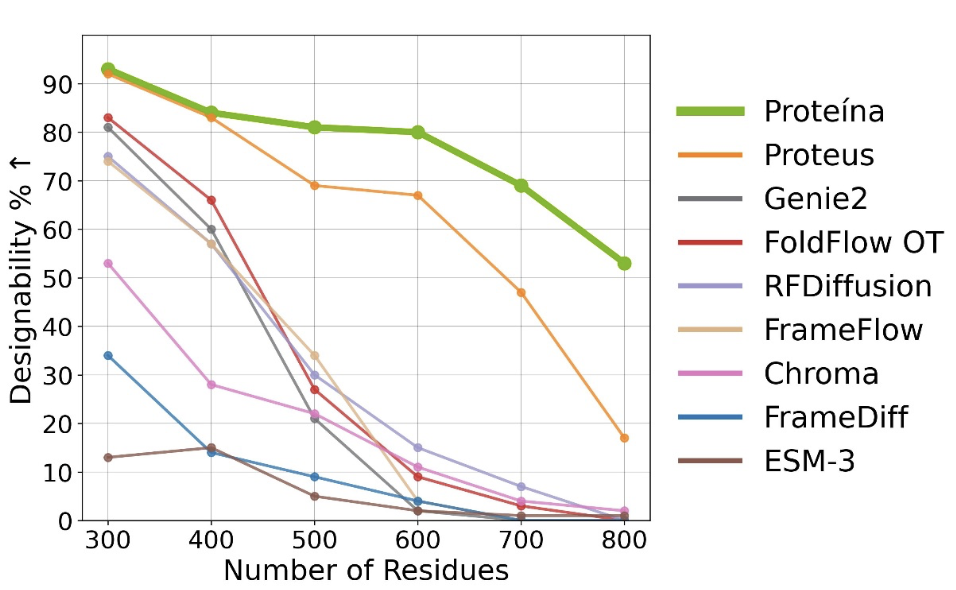
Recently, diffusion- and flow-based generative models of protein structures have emerged as a powerful tool for de novo protein design. Here, we develop Proteina, a new large-scale flow-based protein backbone generator that utilizes hierarchical fold class labels for conditioning and relies on a tailored scalable transformer architecture with up to 5x as many parameters as previous models. To meaningfully quantify performance, we introduce a new set of metrics that directly measure the distributional similarity of generated proteins with reference sets, complementing existing metrics. We further explore scaling training data to millions of synthetic protein structures and explore improved training and sampling recipes adapted to protein backbone generation. This includes fine-tuning strategies like LoRA for protein backbones, new guidance methods like classifier-free guidance and autoguidance for protein backbones, and new adjusted training objectives. Proteina achieves state-of-the-art performance on de novo protein backbone design and produces diverse and designable proteins at unprecedented length, up to 800 residues. The hierarchical conditioning offers novel control, enabling high-level secondary-structure guidance as well as low-level fold-specific generation.

Proteina visualization

Improving protein optimization with smoothed fitness landscapes

Andrew Kirjner*, Jason Yim*, Raman Samusevich, Shahar Bracha, Tommi Jaakkola, Regina Barzilay, and Ila Fiete
International Conference on Learning Representations 2024

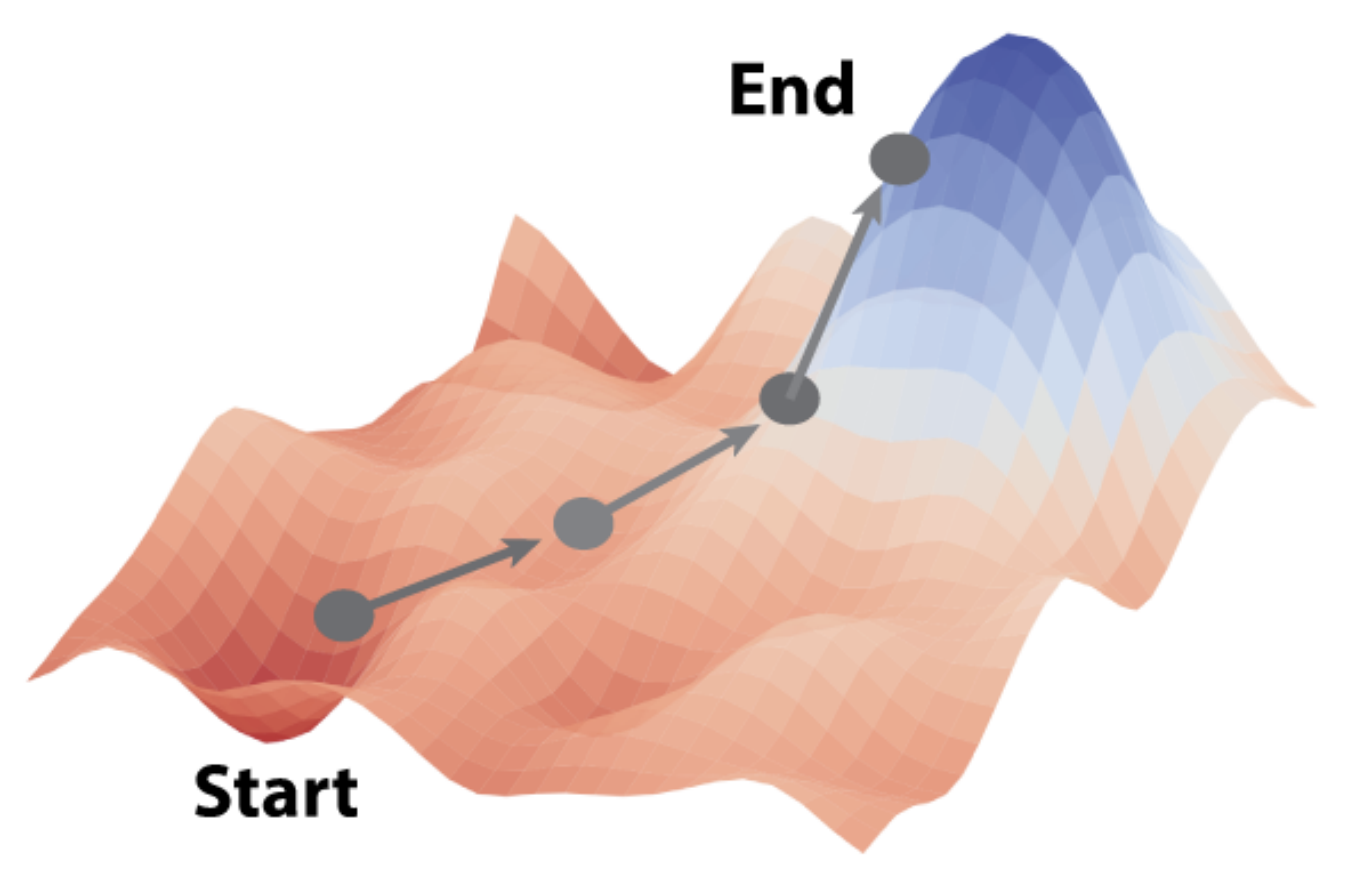
The ability to engineer novel proteins with higher fitness for a desired property would be revolutionary for biotechnology and medicine. Modeling the combinatorially large space of sequences is infeasible; prior methods often constrain optimization to a small mutational radius, but this drastically limits the design space. Instead of heuristics, we propose smoothing the fitness landscape to facilitate protein optimization. First, we formulate protein fitness as a graph signal then use Tikunov regularization to smooth the fitness landscape. We find optimizing in this smoothed landscape leads to improved performance across multiple methods in the GFP and AAV benchmarks. Second, we achieve state-of-the-art results utilizing discrete energy-based models and MCMC in the smoothed landscape. Our method, called Gibbs sampling with Graph-based Smoothing (GGS), demonstrates a unique ability to achieve 2.5 fold fitness improvement (with in-silico evaluation) over its training set. GGS demonstrates potential to optimize proteins in the limited data regime. Code: this https URL

GGS visualization

Diffusion probabilistic modeling of protein backbones in 3D for the motif-scaffolding problem

Brian L. Trippe*, Jason Yim*, Doug Tischer, David Baker, Tamara Broderick, Regina Barzilay, and Tommi Jaakkola
International Conference on Learning Representations 2023

Construction of a scaffold structure that supports a desired motif, conferring protein function, shows promise for the design of vaccines and enzymes. But a general solution to this motif-scaffolding problem remains open. Current machine-learning techniques for scaffold design are either limited to unrealistically small scaffolds (up to length 20) or struggle to produce multiple diverse scaffolds. We propose to learn a distribution over diverse and longer protein backbone structures via an E(3)-equivariant graph neural network. We develop SMCDiff to efficiently sample scaffolds from this distribution conditioned on a given motif; our algorithm is the first to theoretically guarantee conditional samples from a diffusion model in the large-compute limit. We evaluate our designed backbones by how well they align with AlphaFold2-predicted structures. We show that our method can (1) sample scaffolds up to 80 residues and (2) achieve structurally diverse scaffolds for a fixed motif.

Science

De novo design of protein structure and function with RFdiffusion

Joseph L. Watson*, David Juergens*, Nathaniel R. Bennett*, Brian L. Trippe*, Jason Yim*, Helen E. Eisenach*, Woody Ahern*, Andrew J. Borst, Robert J. Ragotte, Lukas F. Milles, Basile I. M. Wicky, Nikita Hanikel, Samuel J. Pellock, Alexis Courbet, William Sheffler, Jue Wang, Preetham Venkatesh, Isaac Sappington, Susana Vázquez Torres, Anna Lauko, Valentin De Bortoli, Emile Mathieu, Regina Barzilay, Tommi S. Jaakkola, Frank DiMaio, Minkyung Baek, and David Baker
Nature 2023

There has been considerable recent progress in designing new proteins using deep-learning methods1,2,3,4,5,6,7,8,9. Despite this progress, a general deep-learning framework for protein design that enables solution of a wide range of design challenges, including de novo binder design and design of higher-order symmetric architectures, has yet to be described. Diffusion models10,11 have had considerable success in image and language generative modelling but limited success when applied to protein modelling, probably due to the complexity of protein backbone geometry and sequence–structure relationships. Here we show that by fine-tuning the RoseTTAFold structure prediction network on protein structure denoising tasks, we obtain a generative model of protein backbones that achieves outstanding performance on unconditional and topology-constrained protein monomer design, protein binder design, symmetric oligomer design, enzyme active site scaffolding and symmetric motif scaffolding for therapeutic and metal-binding protein design. We demonstrate the power and generality of the method, called RoseTTAFold diffusion (RFdiffusion), by experimentally characterizing the structures and functions of hundreds of designed symmetric assemblies, metal-binding proteins and protein binders. The accuracy of RFdiffusion is confirmed by the cryogenic electron microscopy structure of a designed binder in complex with influenza haemagglutinin that is nearly identical to the design model. In a manner analogous to networks that produce images from user-specified inputs, RFdiffusion enables the design of diverse functional proteins from simple molecular specifications.

Scalable emulation of protein equilibrium ensembles with generative deep learning

Sarah Lewis, Tim Hempel, Jose Jimenez-Luna, Michael Gastegger, Yu Xie, Andrew Y. K. Foong, Victor Garcia Satorras, Osama Abdin, Bastiaan S. Veeling, Iryna Zaporozhets, Yaoyi Chen, Soojung Yang, Arne Schneuing, Jigyasa Nigam, Federico Barbero, Vincent Stimper, Andrew Campbell, Jason Yim, Marten Lienen, Yu Shi, Shuxin Zheng, Hannes Schulz, Usman Munir, Cecilia Clementi, Frank Noe
Science 2025

Following the sequence and structure revolutions, predicting functionally relevant protein structure changes at scale remains an outstanding challenge. We introduce BioEmu, a deep learning system that emulates protein equilibrium ensembles by generating thousands of statistically independent structures per hour on a single graphics processing unit (GPU). BioEmu integrates more than 200 milliseconds of molecular dynamics (MD) simulations, static structures, and experimental protein stabilities using new training algorithms. It captures diverse functional motions—including cryptic pocket formation, local unfolding, and domain rearrangements—and predicts relative free energies with 1 kilocalorie per mole accuracy compared with millisecond-scale MD and experimental data. BioEmu provides mechanistic insights by jointly modeling structural ensembles and thermodynamic properties. This approach amortizes the cost of MD and experimental data generation, demonstrating a scalable path toward understanding and designing protein function.

Atom-level enzyme active site scaffolding using RFdiffusion2

Woody Ahern*, Jason Yim*, Doug Tischer*, Saman Salike, Seth M. Woodbury, Donghyo Kim, Indrek Kalvet, Yakov Kipnis, Brian Coventry, Han Raut Altae-Tran, Magnus S. Bauer, Regina Barzilay, Tommi S. Jaakkola, Rohith Krishna, David Baker
Nature Methods 2025

Designing new enzymes typically begins with idealized arrangements of catalytic functional groups around a reaction transition state, then attempts to generate protein structures that precisely position these groups. Current AI-based methods can create active enzymes but require predefined residue positions and rely on reverse-building residue backbones from side-chain placements, which limits design flexibility. Here we show that a new deep generative model, RoseTTAFold diffusion 2 (RFdiffusion2), overcomes these constraints by designing enzymes directly from functional group geometries without specifying residue order or performing inverse rotamer generation. RFdiffusion2 successfully generates scaffolds for all 41 active sites in a diverse benchmark, compared to 16 using previous methods. We further design enzymes for three distinct catalytic mechanisms and identify active candidates after experimentally testing fewer than 96 sequences in each case. These results highlight the potential of atomic-level generative modeling to create de novo enzymes directly from reaction mechanisms.

Computational design of metallohydrolases

Donghyo Kim, Seth M. Woodbury, Woody Ahern, Doug Tischer, Nikita Hanikel, Saman Salike, Jason Yim, Samuel J. Pellock, Anna Lauko, Indrek Kalvet, Donald Hilvert, David Baker
Nature 2025

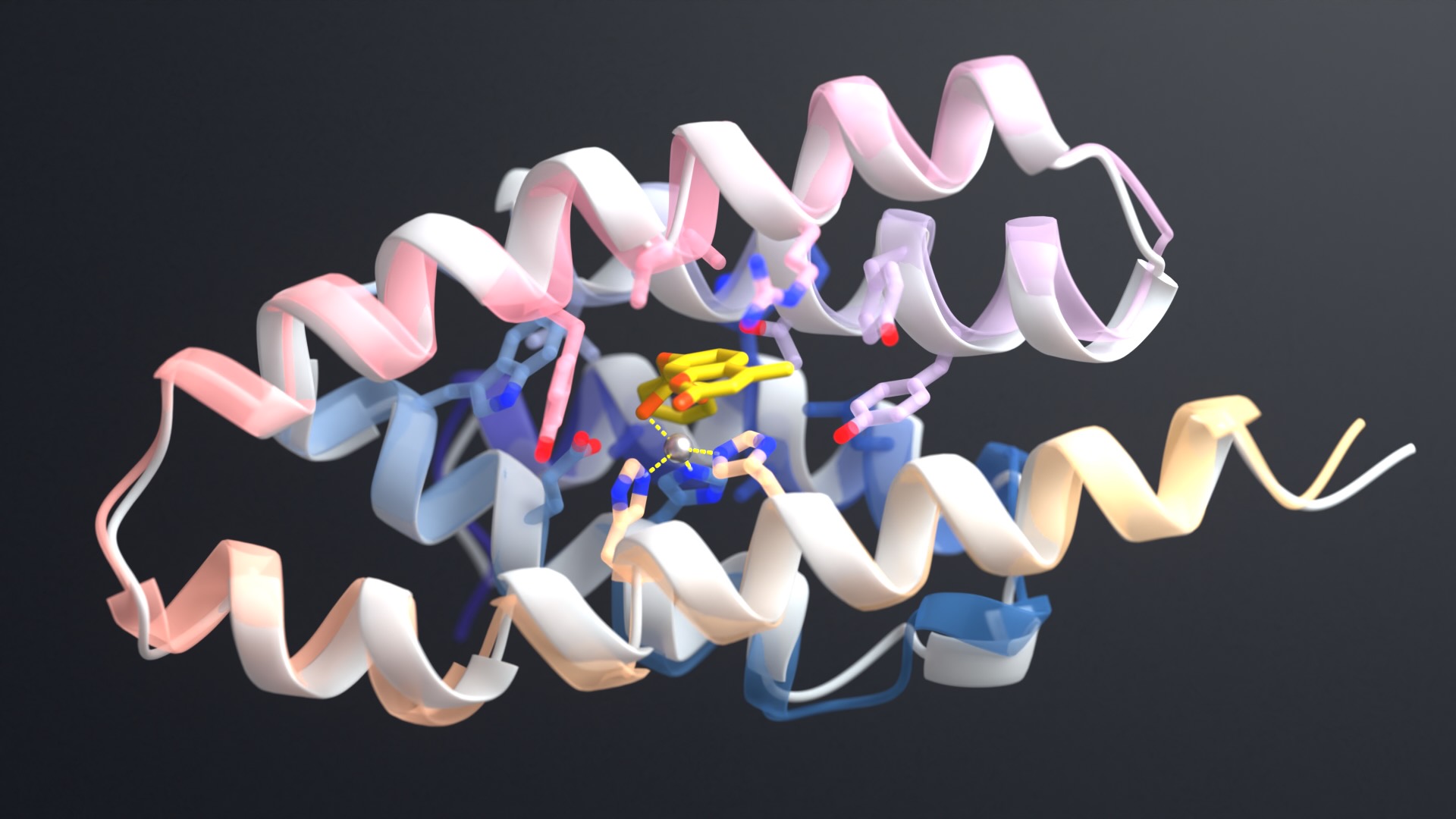
De novo enzyme design seeks to build proteins containing ideal active sites with catalytic residues surrounding and stabilizing the transition state(s) of the target chemical reaction1,2,3,4,5,6,7. The generative artificial intelligence method RFdiffusion8,9 solves this problem, but requires specifying both the sequence position and backbone coordinates for each catalytic residue, limiting sampling. Here we introduce RFdiffusion2, which eliminates these requirements, and use it to design zinc metallohydrolases starting from quantum chemistry-derived active site geometries. From an initial set of 96 designs tested experimentally, the most active has a catalytic efficiency (kcat/KM) of 16,000 M−1 s−1, orders of magnitude higher than previously designed metallohydrolases6,7,10,11. A second round of 96 designs yielded 3 additional highly active enzymes, with kcat/KM values of up to 53,000 M−1 s−1 and a catalytic rate constant (kcat) of up to 1.5 s−1. The design models of the four most active designs differ from known structures and from each other, and the crystal structure of the most active design is very close to the design model, demonstrating the accuracy of the design method. The most active enzymes are predicted by PLACER12 and Chai-1 (ref. 13) to have preorganized active sites that effectively position the substrate for nucleophilic attack by a water molecule activated by the bound metal. The ability to generate highly active enzymes directly from the computer, without experimental optimization, should enable a new generation of potent designer catalysts14,15.

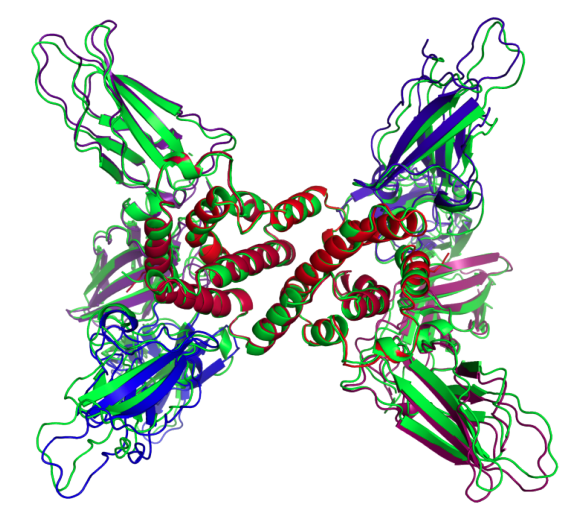
Metallohydrolase

Protein complex prediction with AlphaFold-Multimer

Richard Evans, Michael O’Neill, Alexander Pritzel, Natasha Antropova, Andrew Senior, Tim Green, Augustin Žı́dek, Russ Bates, Sam Blackwell, Jason Yim, Olaf Ronneberger, Sebastian Bodenstein, Michal Zielinski, Alex Bridgland, Anna Potapenko, Andrew Cowie, Kathryn Tunyasuvunakool, Rishub Jain, Ellen Clancy, Pushmeet Kohli, John Jumper, and Demis Hassabis
bioRxiv 2022

While the vast majority of well-structured single protein chains can now be predicted to high accuracy due to the recent AlphaFold [1] model, the prediction of multi-chain protein complexes remains a challenge in many cases. In this work, we demonstrate that an AlphaFold model trained specifically for multimeric inputs of known stoichiometry, which we call AlphaFold-Multimer, significantly increases accuracy of predicted multimeric interfaces over input-adapted single-chain AlphaFold while maintaining high intra-chain accuracy. On a benchmark dataset of 17 heterodimer proteins without templates (introduced in [2]) we achieve at least medium accuracy (DockQ [3] ≥ 0.49) on 13 targets and high accuracy (DockQ ≥ 0.8) on 7 targets, compared to 9 targets of at least medium accuracy and 4 of high accuracy for the previous state of the art system (an AlphaFold-based system from [2]). We also predict structures for a large dataset of 4,446 recent protein complexes, from which we score all non-redundant interfaces with low template identity. For heteromeric interfaces we successfully predict the interface (DockQ ≥ 0.23) in 70% of cases, and produce high accuracy predictions (DockQ ≥ 0.8) in 26% of cases, an improvement of +27 and +14 percentage points over the flexible linker modification of AlphaFold [4] respectively. For homomeric inter-faces we successfully predict the interface in 72% of cases, and produce high accuracy predictions in 36% of cases, an improvement of +8 and +7 percentage points respectively.

AlphaFold-multimer visualization

Predicting conversion to wet age-related macular degeneration using deep learning

Jason Yim*, Reena Chopra*, Terry Spitz, Jim Winkens, Annette Obika, Christopher Kelly, Harry Askham, Marko Lukic, Josef Huemer, Katrin Fasler, and others
Nature Medicine 2020

Progression to exudative ‘wet’ age-related macular degeneration (exAMD) is a major cause of visual deterioration. In patients diagnosed with exAMD in one eye, we introduce an artificial intelligence (AI) system to predict progression to exAMD in the second eye. By combining models based on three-dimensional (3D) optical coherence tomography images and corresponding automatic tissue maps, our system predicts conversion to exAMD within a clinically actionable 6-month time window, achieving a per-volumetric-scan sensitivity of 80% at 55% specificity, and 34% sensitivity at 90% specificity. This level of performance corresponds to true positives in 78% and 41% of individual eyes, and false positives in 56% and 17% of individual eyes at the high sensitivity and high specificity points, respectively. Moreover, we show that automatic tissue segmentation can identify anatomical changes before conversion and high-risk subgroups. This AI system overcomes substantial interobserver variability in expert predictions, performing better than five out of six experts, and demonstrates the potential of using AI to predict disease progression.

Back to top · Jason's Brain